
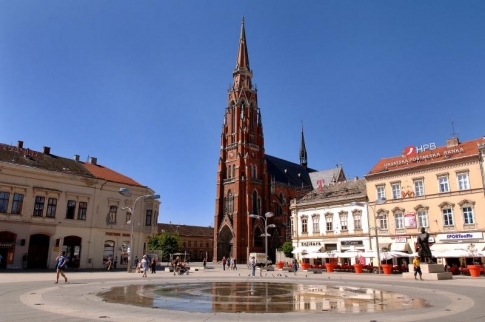
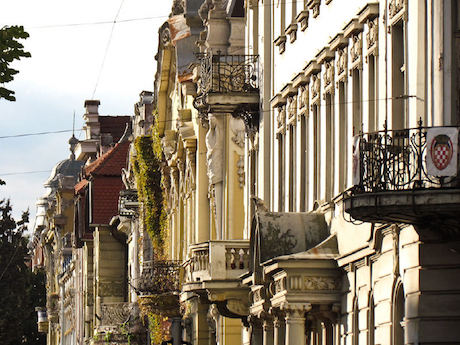
Rich culture, valuable Secession-style architecture, perfectly represented on Europska avenija (“European Avenue”) as the most beautiful complex of secessionist edifices in the world, the Baroque-style Tvrđa, the river Drava, an abundance of historical gardens and landscape architecture monuments, as well as the nearby Special Zoological Reserve and Nature Park Kopački rit – all of these landmarks put Osijek on the map of the most beautiful Croatian cities and promote it as a great place to live in. The city’s cultural offer includes the Croatian National Theatre, Branko Mihaljević Children’s Theatre, historical cinemas Urania (in a former Masonic lodge building) and Europa, Archaeological Museum, Museum of Slavonia, Visual Arts Gallery and a State Archive that keeps the archival treasures of the region. Another stand-out feature of the City on the Drava is surely its Neo-Gothic Co-Cathedral of Saint Peter and Paul, adjacent to the central city square and built with the generous funding and efforts of Bishop Josip Juraj Strossmayer. The economic strength of Osijek, the wealth of its citizens and the importance it has had in the cultural, educational and economic development of Croatia reflect in the influence and power of the aristocratic families of Pejačević, Adamović and Norman-Prandau, numerous business people, well-to-do merchants and craftsmen who, in the Austro-Hungarian period, chose Osijek for its place of work and living, but also in the fact that Croatian Nobel laureates Lavoslav Ružička and Vladimir Prelog, Academy Award winner Branko Lustig, composer Lav Mirski, violin virtuoso Franjo Krežma, painting masters Adolf Waldinger, Bela Csikos-Sessia and Ivan Rein, as well as numerous other writers, painters, actors and scientist were born, lived or worked in the city, leaving an indelible mark and giving its citizens a deserved sense of pride and belonging.

According to historical data, the Illyrian-Celtic settlement of Mursa existed in the territory of modern-day Osijek in the 3rd century BC, more precisely in the present-day quarter of Donji grad. During the reign of Emperor Augustus (8 AD), the Romans occupied Mursa and its neighbouring areas, transforming it into an important road junction and trading centre. Mursa reached its peak during the reign of Emperor Hadrian (2nd century AD), who proclaimed it a Roman colony (Colonia Aelia Mursa). Numerous architectural and artistic findings as well as items of everyday use found in the sites of modern-day Donji grad and University Campus testify to this fact. Having been sacked by the Goths in the late 4th and early 5th centuries, then occupied by the Huns in 441, it was destroyed, and in the early 7th century Croats settled to the west of its ruins.

After the unification of the northern and southern regions under Croatia’s first king, Tomislav, in 925, the territory of eastern Croatia became part of the Croatian state. Following the creation of the Croatian-Hungarian union with the signing of the Pacta Conventa document in 1102, there was a growing Hungarian influence in Osijek. Thus the name of the new settlement of Osijek (to the west of the Roman Mursa) was first mentioned in a 1196 document in Hungarian form – Eszék.
”According to historical sources, the Illyrian-Celtic settlement of Mursa existed in the territory of modern-day Osijek in the 3rd century BC, more precisely in the present-day quarter of Donji grad.”

Due to its location as a road junction and a crossing site over the river Drava, the medieval Osijek became an important commercial and administrative seat, but the city’s Renaissance-Humanist development was halted by the Ottoman occupation in 1526. During the Ottoman rule, Osijek was built-up and fortified, and its oriental visage was supplemented by the Suleiman Bridge, constructed in 1566. Osijek remained under the Ottoman government until its liberation on 29 September 1687, and then it was integrated into the Habsburg Monarchy, along with the rest of the territory of eastern Croatia. Under Austrian authority, today’s Baroque-style Tvrđa was built (1712 – 1721), as well as other new city quarters. In 1690, the city government was established, and eight years later Osijek adopted its City Statute, taking after other Central-European cities. In 1798, Osijek was the largest city in Croatia with a population of 8,000 (at the time, the capital city of Zagreb had 7,706 residents). The first secondary school (a so-called “gymnasium”) was opened in 1729, the first printing house in 1735, followed by the establishment of the high theological and philosophical study (Studium Generalae Theologicum Primae Classis). Osijek was declared a free royal city on 28 August 1809, which marked the beginning of a strong development.

The economic and cultural growth of Osijek continued throughout the 19th century with new factories (brewery, leather factory, textile and food industries), one of the largest and most state-of-the-art hospitals (in 1874), secondary schools, teacher and merchant academies. Following World War I and the fall of the Austro-Hungarian Monarchy, Osijek became part of a new state, the Kingdom of Serbs, Croats and Slovenes, in 1929 renamed to the Kingdom of Yugoslavia. The economic and cultural development of Osijek was at a standstill during that time. The brief period after the breakup of the Kingdom of Yugoslavia, during which Croatia was autonomous under the name of the Independent State of Croatia (1945), is still a subject of numerous scientific disputes and is associated with a sense of embarrassment among Croatian citizens and in some of the national historiography. Strong anti-fascist activity, in spite of the quisling creation of ISC, after World War II enabled Croatia to become a federal unit of the Federative People’s Republic of Yugoslavia, later called the Socialist Federative Republic of Yugoslavia. The foundation of the University in 1975 marked the beginning of Osijek’s development as a university city. In that period, numerous cultural edifices, industrial facilities, individual faculties and primary and secondary schools were built. The breakup of SFRY and Croatia’s gaining of independence in 1991 was followed by the Homeland War in which Osijek suffered heavy devastation and significant human losses. In spite of being surrounded by enemy forces from three sides, electricity, drinking water and food supply unfolded without disturbance thanks to the immense efforts of citizens, defenders and the entire Croatia. In mid-1992, due to international peace mediation and the arrival of the transitional UN administration to the occupied Croatian areas in the vicinity of Osijek, the shelling of the city ceased and its gradual post-war revitalisation and reconstruction began.

”The economic and cultural growth of Osijek continued throughout the 19th century with new factories (brewery, leather factory, textile and food industries), one of the largest and most state-of-the-art hospitals (in 1874), secondary schools, teacher and merchant academies…”