
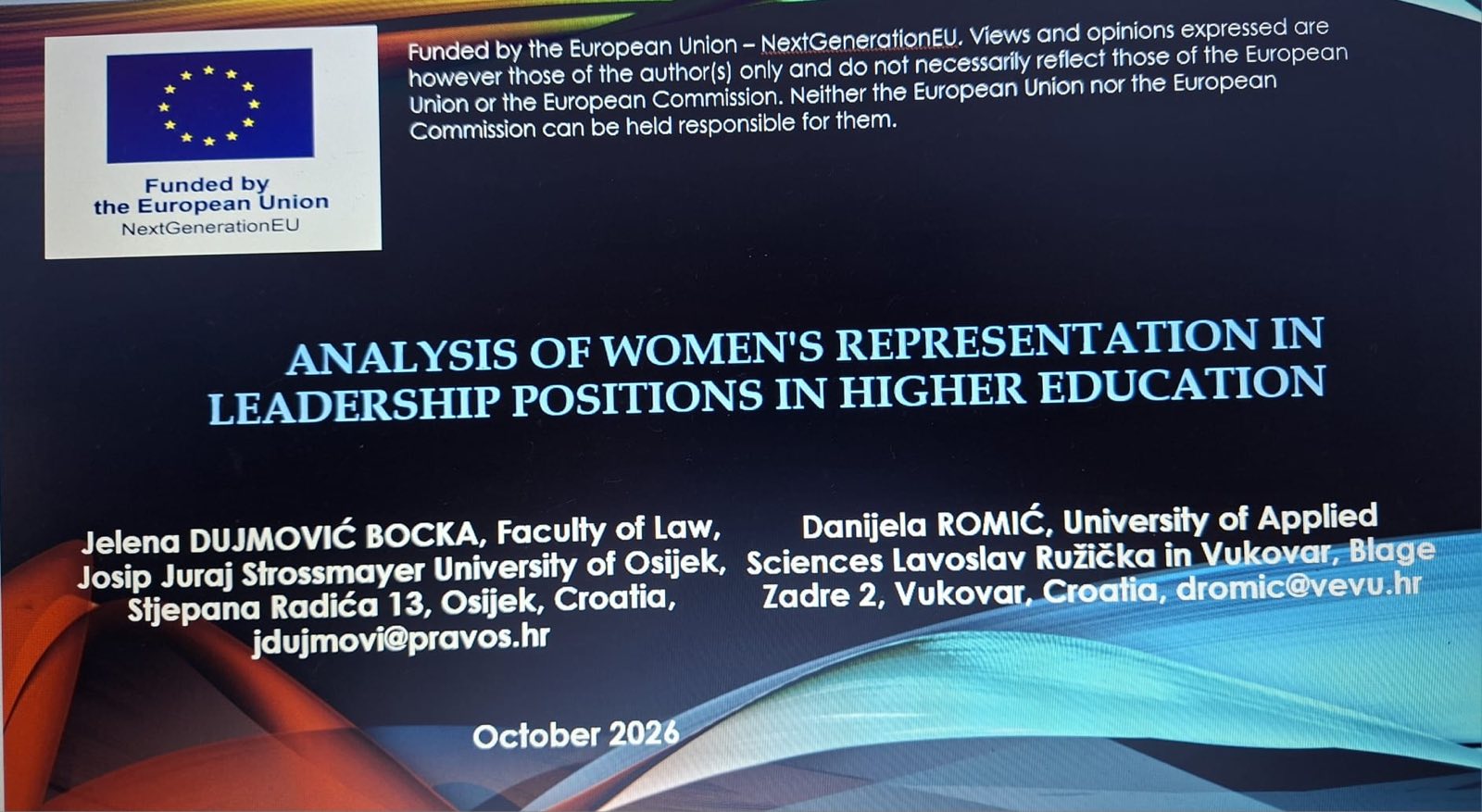
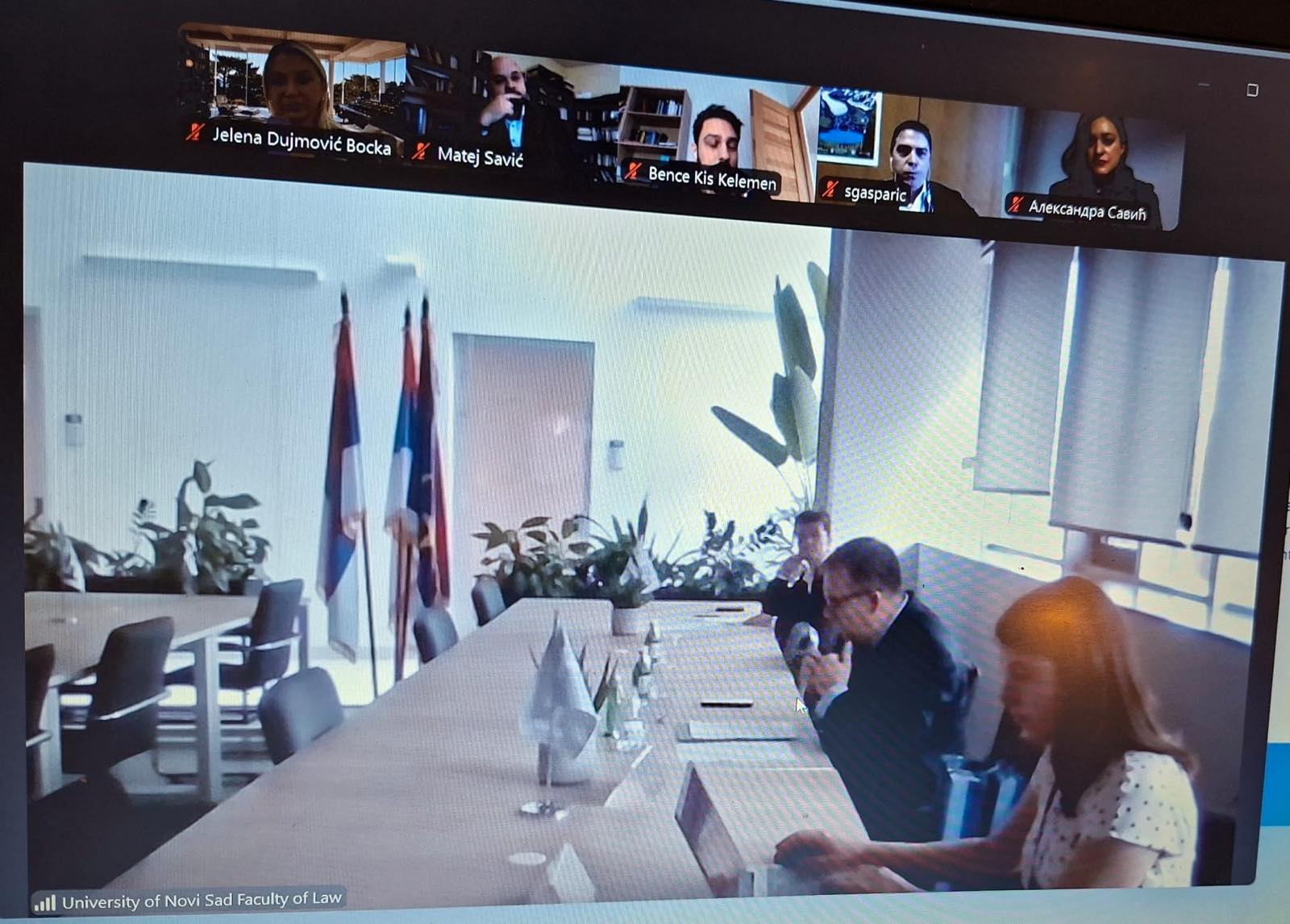
Jelena Dujmović Bocka, PhD, Associate Professor, Head of Work Package 4 – Science Communication and Student Engagement, delivered an online presentation in English entitled “Analysis of Women’s Representation in Leadership Positions in Higher Education” as part of this year’s 8th Annual International Scientific Conference Legal Tradition and New Legal Challenges.
The question of whether women are adequately represented in leadership and management positions within the higher education system is frequently raised. The presentation addressed this issue by analysing the representation of women in leadership positions at the constituent units of Josip Juraj Strossmayer University of Osijek. The authors conducted empirical research by reviewing the official websites of all University constituent units and their governing bodies in order to collect data on the total number of women holding leadership positions, specifically the positions of deans and vice-deans. The aim of the research was to determine the representation of women in the positions of dean and vice-dean at the University and to examine the gender composition of its governing bodies.Within the framework of the research, the authors formulated two hypotheses. The main hypothesis posits that men are more strongly represented in the position of dean within the governance structures of the University’s constituent units. The secondary hypothesis posits that the proportion of women is higher in deputy leadership positions than in the highest leadership positions.
During the presentation, a theoretical framework concerning gender equality in higher education was established, and the key legislative provisions governing this area were analysed. The analysis was based on constitutional principles, the Gender Equality Act, the Act on Higher Education and Scientific Activity, the Anti-Discrimination Act, the National Public Administration Development Plan for the period 2022–2027, as well as relevant European documents promoting the balanced representation of women and men in decision-making and management positions.The scientific contribution of this research lies in establishing a theoretical framework for examining the representation of women in the governing structures of higher education institutions, conducting empirical research, and generating findings that point to asymmetries in women’s representation in the highest leadership positions compared to deputy leadership positions. The research findings are expected to confirm differences in women’s representation between the highest and deputy leadership positions and to identify patterns of gender imbalance within the governance structures of the University’s constituent units.



Funded by the European Union – NextGenerationEU. The views and opinions expressed are those of the author only and do not necessarily reflect the official position of the European Union or the European Commission. Neither the European Union nor the European Commission can be held responsible for them.