
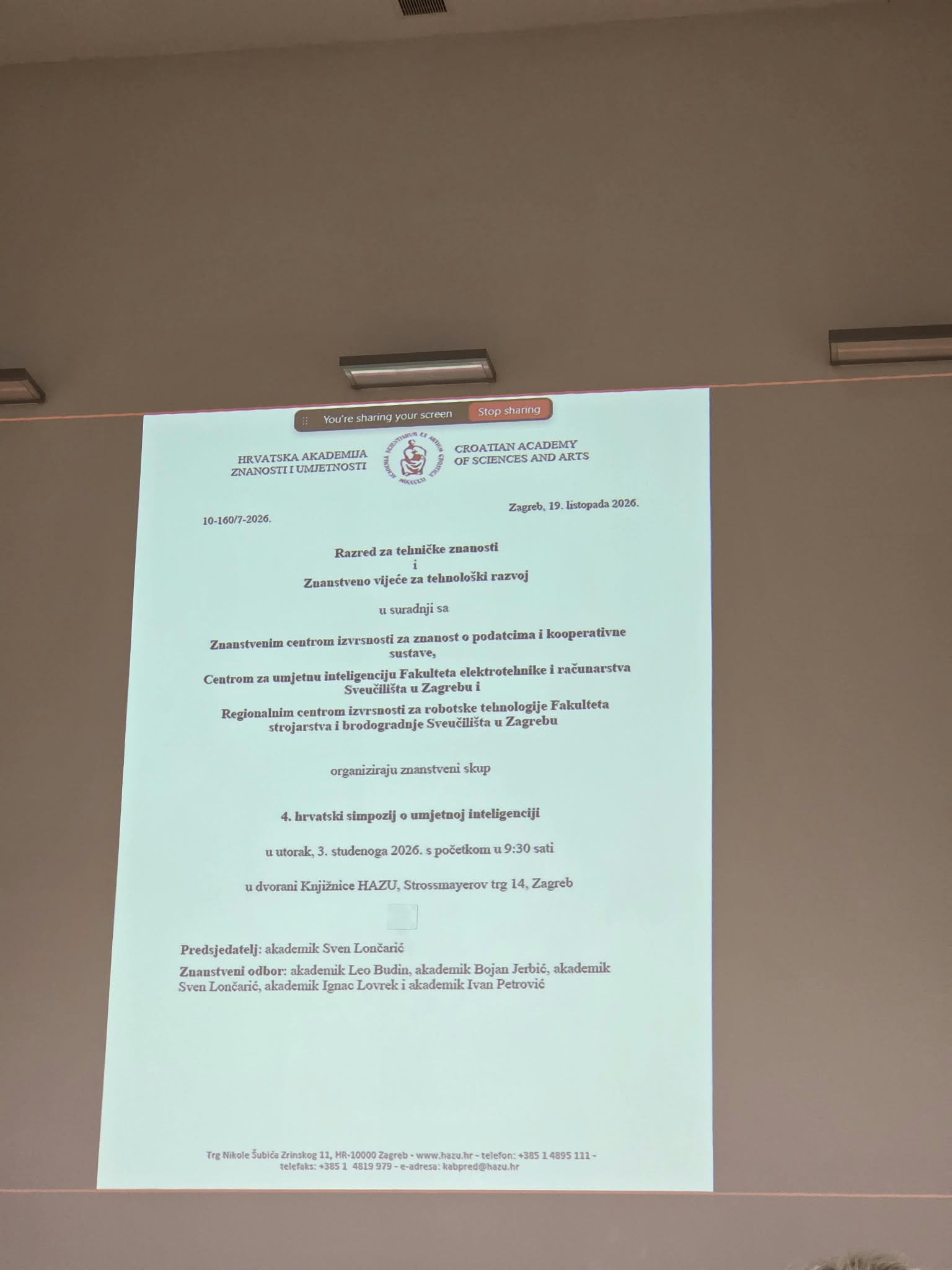
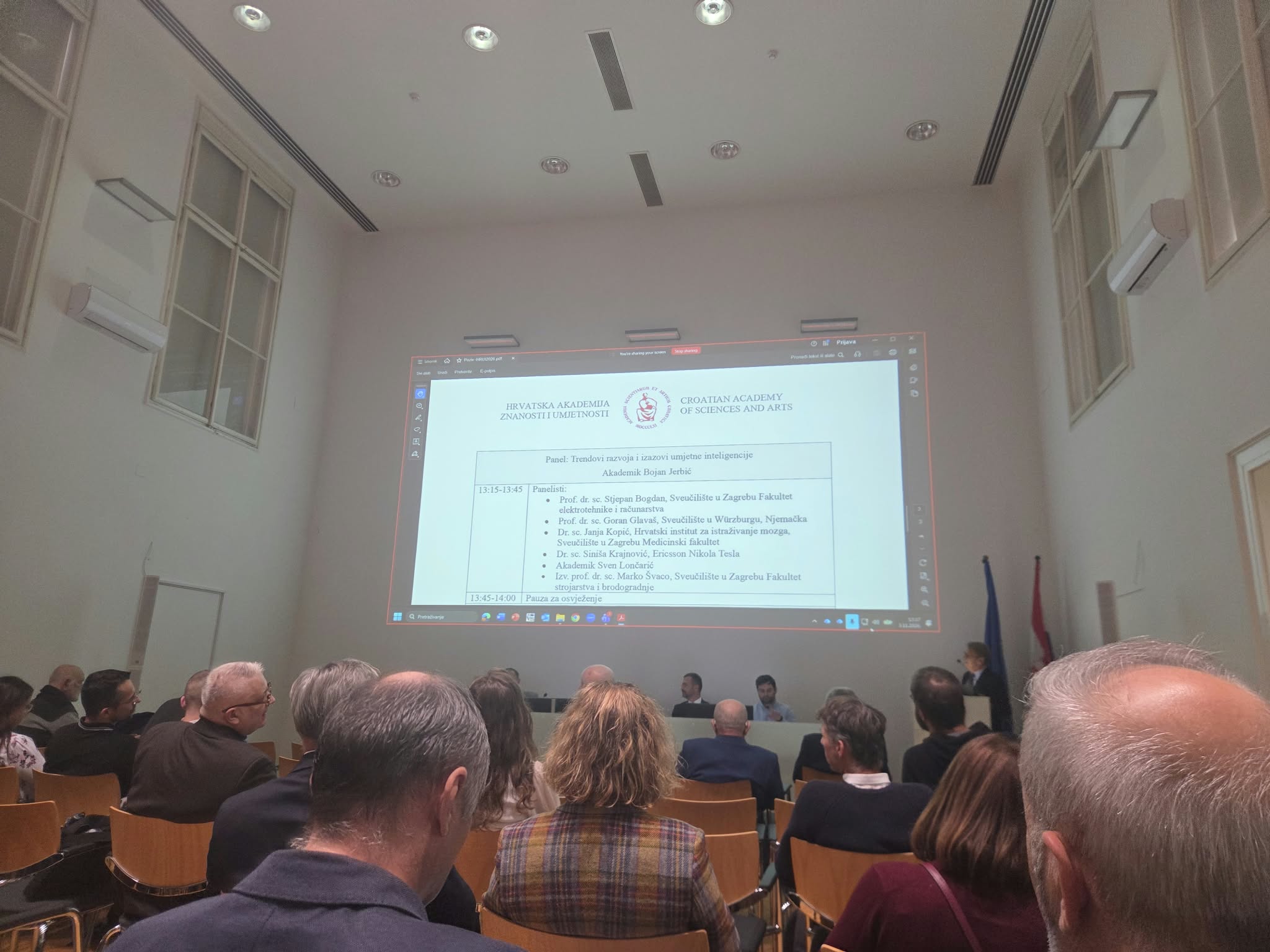
Project team member Ivan Vidaković, LL.M., delivered a presentation at the 4th Croatian Symposium on Artificial Intelligence (HRUI 2026). The symposium was organized by the Scientific Council for Technological Development of the Croatian Academy of Sciences and Arts and took place in Zagreb on November 3, 2026. The presentation, entitled “The EU Artificial Intelligence Act – An Incentive or an Obstacle to the Use of Artificial Intelligence in the Judiciary?”, was held within the section “Artificial Intelligence in Technical, Medical, and Legal Sciences,” chaired by Academician Ignac Lovrek. The presentation analyzes how the EU Artificial Intelligence Act addresses the deployment of AI systems in the judicial system. Special emphasis is placed on Point 8, Sub-point (a) of Annex III to the Regulation, under which AI systems intended to be used by a judicial authority to research and interpret facts and the law, and to apply the law to a concrete set of facts, are classified as high-risk. The presentation highlights the obligations such systems impose on both providers and judicial authorities. It further warns of the possibility that a court, pursuant to Article 25 of the Regulation, may itself assume the provider’s obligations if it utilizes a large language model (LLM) to interpret the law in a specific case.
The draft guidelines of the European Commission on the classification of high-risk AI systems were also examined. According to the draft, the searching of legal sources, the anonymization of decisions, and case assignment remain outside the high-risk category, whereas systems that suggest case law, construct legal reasoning, or draft decisions fall within it. In doing so, the guidelines emphasize that the concept of human-in-the-loop does not, per se, alter the classification of the system. Additionally, the draft National Plan for the Development of Artificial Intelligence for the period up to 2032 was analyzed, which directs the use of AI in the judiciary toward analytical support while explicitly excluding judicial decision-making. In conclusion, it is emphasized that the Regulation is neither an absolute incentive nor a barrier, but rather a conditional incentive. It legitimizes the use of AI in the judiciary only as long as it remains an auxiliary tool and final decision-making remains a human activity. The issue of regulation thus becomes a question of judicial independence and impartiality. De lege ferenda, it is advocated that guidelines for risk assessment and fundamental rights impact assessments clearly delineate permissible and high-risk forms of use, thereby ensuring genuine human oversight, transparency, and the contestability of output results.

Funded by the European Union – NextGenerationEU. The views and opinions expressed are those of the author only and do not necessarily reflect the official position of the European Union or the European Commission. Neither the European Union nor the European Commission can be held responsible for them.