
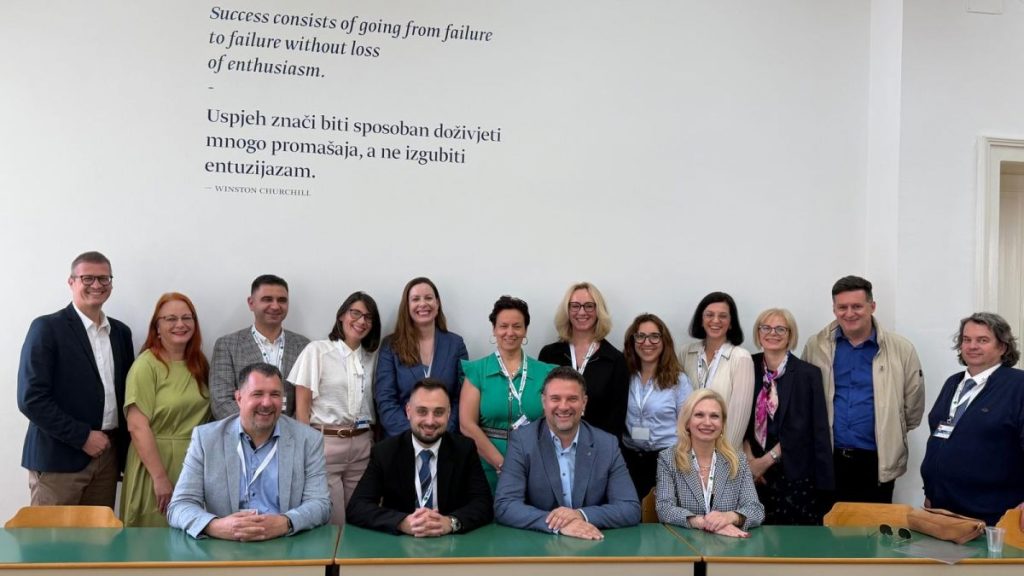
Members of the project team, Ante Novokmet, PhD, Full Professor and Ivan Vidaković, LL. M, presented their paper entitled “PROTECTION OF VICTIMS OF HUMAN TRAFFICKING IN CROATIAN CRIMINAL PROCEEDINGS: SUPRANATIONAL STANDARDS AND GRETA RECOMMENDATIONS” at the international scientific conference entitled “EU as a Global Player: Geopolitical Position of the EU in the New Global Order”, which was held in Osijek on 11–12 June 2026 and organised by the Faculty of Law Osijek.
The authors in the paper examines the protection of victims of human trafficking in Croatian criminal proceedings through the lens of supranational standards, selected case law of the European Court of Human Rights, relevant European Union law, and GRETA recommendations. The starting point of the analysis is the development of positive obligations under Article 4 of the European Convention on Human Rights, particularly the obligation of States to establish an effective legislative and administrative framework, take timely operational measures, and conduct an effective investigation whenever there are credible indications of human trafficking. Special attention is given to the case law of the European Court of Human Rights and more recent developments concerning proactive investigations, victim identification, and the avoidance of excessive reliance on victims’ testimony. The paper analyses the Croatian legal framework, including the Criminal Procedure Code, Criminal Code, Social Welfare Act, Act on the Suppression of Undeclared Work, Aliens Act, and related legislation. It assesses recent legislative amendments aimed at strengthening victims’ rights, access to support services, protection from secondary victimisation, and procedural participation. However, the analysis also identifies persistent shortcomings highlighted in GRETA’s third and fourth evaluation reports, particularly concerning early identification of victims, access to compensation, the non-punishment principle,
protection of migrant workers, labour exploitation, and insufficient operational mechanisms for effective assistance and protection. The
paper argues that Croatia has made significant progress in developing a formally comprehensive framework for combating trafficking in human beings, but that its practical effectiveness depends on clearer statutory mechanisms. In particular, the paper proposes a more precise procedural mechanism for the non-punishment of victims, improved access to compensation within criminal proceedings, stronger early identification procedures, and better coordination between criminal justice, labour, migration, social welfare, and victim-support systems.
Funded by the European Union – NextGenerationEU. The views and opinions expressed are those of the author only and do not necessarily reflect the official position of the European Union or the European Commission. Neither the European Union nor the European Commission can be held responsible for them.